Growing & Winemaking
by Andy Starr
How to Prepare for the Next Disaster
There is little to add to the reporting about the firestorm that struck Mendocino, Napa and Sonoma wine country Oct. 8, 2017. It was unlike any other disaster to hit California.


Viewpoint
by Mary Loftness and Paul Wagner
What DtC Wine Sales Can Learn From Cruise Lines and Casinos
Given the importance of direct-to-consumer (DtC) sales in the wine industry, one might assume we have found the holy grail of customer relationship management. But compared to other hospitality industries such as cruise lines and casino gaming, we fall far short of best practices.

Editor's Letter
by Jim Gordon
An Issue and a Conference Focused on Oak
Oak is our main theme this month, both in the magazine and at the upcoming Wines & Vines Oak Conference on April 26. It will be our third annual conference and trade show focusing tightly on barrels and oak adjuncts.

Grounded Grapegrowing
by Glenn McGourty
Production Costs for Alternative Winegrowing Farming Systems
Certified organic and Biodynamic winegrowing are separate systems that use independent third-party organizations to verify members are following prescribed farming practices. Winegrowers have their vineyards certified for a variety of reasons, including pursuing market niches, addressing environmental stewardship and also wine quality.

Viewpoint
by Jim Law
One Place, One Life
Starting from scratch: Life's circumstances led me to Virginia in 1981. I was hired to expand an existing vineyard and start up a winery in the Shenandoah Valley. It didn't take long for me to realize that I wanted to set my own roots here.
Growing & Winemaking
by Andy Starr
How Wineries Use Vineyard Technology
A Google search for the exact phrase “wines are made in the vineyard” produced 40,600 results, making it one of the industry’s mantras, along with “our Chardonnay is buttery” and “I thought we’d be cash-flow positive by now.

Wine Industry Finance
by Gabriel Froymovich
Should Growers Make Bulk Wine?
Much attention has been paid recently to wine producers acquiring vineyards to secure affordable, quality supply as grape prices rise. Less discussion has focused on growers who see this rise in profits as a way to invest in themselves by diversifying into wine production.
Editor's Letter
by Jim Gordon
Vineyard Technology Sets Stage for 2017
DRENCHING FLOODS IN CALIFORNIA, bitter cold and snow in the Northwest and absurdly seesawing freezes and thaws in the eastern United States remind us once again how little control grapegrowers have over their crops.
The best way to bring a little more order to this natural chaos is to make yourself as smart as you can.

Vineyard View
by Cliff Ohmart
Lodi Growers Reduce Pesticide Risk
The Lodi wine community has devoted significant attention and energy to implementing sustainable winegrowing practices since the early 1990s. The focus has been on all aspects of vineyard management, from soil quality, nutrient and irrigation management to canopy management, energy efficiency, social equity and pesticide risk.
Editor's Letter
by Jim Gordon
How to Protect Your Barrel Investment
AT $900 PER BARREL for French oak and $450 per barrel for American oak, barrels are a major, major expense for many wineries. Used carefully they will, of course, be worth the money. Barrels can help immensely in elevating your wine to the highest quality that your grapes can deliver.

Viewpoint
by Kristy Charles
Top 10 Things I've Learned as a Winery Owner
As we at Foursight Wines wrap up our first decade as wine business owners, I’ve been thinking quite a lot about the lessons I’ve learned over the years. What would I distill and pass along from our first 10? In that spirit, here is a (slightly salty) list of the top 10 things I’ve learned from a decade of running our own wine business.
Growing & Winemaking
by Andy Starr
Start Planning Equipment Purchases Now
January in the winery. Harvest is in the rearview mirror, and wines are aging or getting ready for bottling. You had some time over the holidays to get reacquainted with your family and resume a normal sleep schedule.

Practical Winery & Vineyard
by Robert Smiley, Ph.D., and Nicholas Simmons
Industry Leaders Optimistic About Premium Wines
Millennials, whose baby boomer parents were the first generation of premium wine drinkers in the United States, are consuming more and higher value wines, driven by a thirst for quality, new experiences and information-sharing, according to wine industry leaders surveyed by the University of California, Davis.

Viewpoint
by Clark Smith
Selecting a Machine for Reverse Osmosis
Reverse osmosis machine sales are suddenly going crazy—up an order of magnitude from past years. Three decades after the introduction of reverse osmosis (RO), wineries are now prosperous enough to afford their own machines, and they are at last getting hip to the technology’s many quality-enhancing powers.

Viewpoint
by Pam Strayer
The Organic Opportunity: Will the U.S. Wine Industry Miss Out?
Every day, it seems the world is trending more and more toward organics. Sales of organic food are skyrocketing. England’s Prince Charles announced that’s he’s joining a new initiative to keep more of the world’s carbon in soils through organic farming techniques.
Editor's Letter
by Jim Gordon
Oak Alternatives, Yeast and a Great Book Excerpt
April is officially the oak alternatives issue, but this one could have also been titled the Grapegrowing Issue or the Yeast Issue. So if you’re not into oak chips like those on the cover—although we know many of you are—read on anyway.
We have four really authoritative viticulture articles in this issue. The first, by Dr. Mark A. Matthews of the University of California, Davis, is the most thought-provoking takedown of conventional wisdom that we have published for many years. Matthews has just published a fascinating book that enthusiastically and carefully takes apart several commonly held misperceptions about grapegrowing and winemaking. It’s called Terroir and Other Myths of Wine Growing (University of California Press).
Grounded Grapegrowing
by Glenn McGourty
Where There's Fire, There's Smoke
California’s climate has certainly changed perceptibly in the past decade, as drought and increased temperatures year-round have affected winegrowing in the state. Besides potential stress to grapevines, another serious consequence is the increased risk of forest and brush fires. Climate change is predicted to increase the frequency and intensity of forest and brush fires for the West Coast. This may eventually cause massive changes to our landscape in terms of types of trees and shrubs that grow. The potential for devastating fires is a grave concern to all living things in or near wilderness areas.
Editor's Letter
by Jim Gordon
How Investors View the Wine Economy
BETWEEN PRODUCTION OF THE FEBRUARY ISSUE and this one for March, our entire staff spent three days at the Unified Wine & Grape Symposium in Sacramento, Calif. It is quite possible we saw you there, too, among the 13,800 attendees.
Unified is always the best and biggest wine industry function of the year, as much for catching up with old friends as for seeing new products and equipment in the trade show. When you add in the conference sessions, there is no better place to get a sense of how our industry is doing.
Vineyard View
by Cliff Ohmart
Seeing Terroir Through the Lens of Science
Terroir and Other Myths of Winegrowing, the new book by Dr. Mark A. Matthews, is a must-read for any wine grape grower or winemaker who has ever wrestled with the most important myths of winegrowing or debated them with colleagues—and that would be all of us! It is also a great read for any wine consumer interested in looking at “the man behind the curtain,” so to speak: the myths promoted by wine writers, tasting room staff, sommeliers and other wine gatekeepers.
Vineyard View
by Cliff Ohmart
Business Model for Inputs Impedes Sustainable Growing
If the goals of sustainable winegrowing are to reduce farming’s environmental footprint and produce more with less, then the input supply chain business model is an impediment to realizing those goals. Success is measured by selling more rather than less, since most input salespeople make commissions on the amounts they sell. Furthermore, many salespeople not only promote inputs to growers (primarily fertilizers and pesticides), they also provide recommendations on how to use them.

Viewpoint
by Mario Zepponi
Predicting Mergers and Acquisitions in 2016; By Mario Zepponi, George Coope and David Von Stroh
The stage for 2016 is set: The U.S. economy continues to expand; capital markets are relatively strong; U.S. wine consumption continues to rise, and consumers’ purchase patterns increasingly favor more expensive wines. Wine sales have increased during the past 16 years at an average of 3.4% per year, reaching 375 million cases (or approximately 2.8 gallons per capita) in 2014. As of 2013, the U.S. became the largest wine market in the world, with plenty of room for continued growth in per-capita consumption.

Growing & Winemaking
by Andrew Starr
Warming to New Tartrate Stabilization Methods
Tartrate stabilization, often called cold stabilization, is a wine treatment for the cosmetic benefit of avoiding tartrate crystal formation. Intellectually you know you don’t really need to do it, but you do it anyway. So the priority is to get it done while minimizing both the risk of degrading wine quality and cost.

Growing & Winemaking
by Fritz Westover
Top Seven Mistakes New Grapegrowers Make
I have worked with many vineyard startups during the past decade and evaluated prospective vineyard sites for countless soon-to-be grapegrowers east of the Rocky Mountains. New growers often start growing grapes while working other jobs or after a previous career—frequently one not related to agriculture.
Editor's Letter
by Jim Gordon
The Winemaking Process From Planting to Packaging
THE MAIN HEADLINE ON THE COVER of this issue is “Work Smarter in 2016.” We don’t mean to imply that you weren’t working smart in 2015, but with all the substantive new research and newly applied practices out there, you’re not yet done with your education.
Editor's Letter
by Jim Gordon
Renew the Pierce's Disease Assessment
THE ASSESSMENT ON WINE GRAPES that was initially approved by California growers in 2001 to fight Pierce’s disease is up for renewal this month. By the time you read this, vineyard owners should have received their ballots in the mail, and now they have until April 28 to return them.
Editor's Letter
by Jim Gordon
A Clean Slate in the Vineyard
IN THE GRAPEGROWING YEAR, March is the month with a clean slate. At least on the West Coast the vines have been pruned, and bud break is about to begin. Growers have counted up the successes and mistakes of the 2014 vintage, made notes about how to improve in 2015, and now it’s time to proceed.
Grounded Grapegrowing
by Glenn McGourty
Creating Effective Weed Control
Vineyard row middles are often covered with living vegetation at least part of the year, usually during the winter. Growers may plant row middles with cover crops or allow weeds and other self-seeding plants to grow, generating living material (biomass). In the past I have written about cover crops and the numerous benefits this plant material brings for vineyard soil health, chemical and physical properties. Growing live vegetation in row middles can make huge differences for soil water storage, soil fertility and vine performance. In this part of the vineyard floor, it is fairly easy to control unwanted vegetation (weeds) by mowing, tilling and occasionally spraying herbicides (not needed in most cases.)
READ MORE »SEE EARLIER EDITIONS OF THIS COLUMN »Editor's Letter
by Jim Gordon
Why Barrels Are Irreplaceable
IN ANY CRAFT, there are certain indispensable, even timeless, tools. Some things work so well for so many fundamental reasons that they become integral and permanent.
I was thinking about this because in our house not long ago we bought a serious new frying pan.
READ MORE »SEE EARLIER EDITIONS OF THIS COLUMN »Vineyard View
by Cliff Ohmart
Lodi Rules Program Turns 10
One of the most common questions I am asked by growers trying to decide whether to participate in a sustainable farming program is, “What’s in it for me?” How does a 1,000% return on investment sound? That was the 2013 ROI for participants in the Lodi Rules for Sustainable Winegrowing Certification program, which celebrates its 10th anniversary this year.
After working together for two years, Protected Harvest (a national nonprofit organization for sustainable farming certification) and the Lodi Winegrape Commission launched the Lodi Rules for Sustainable Winegrowing certification program in 2005. To qualify for certification, a vineyard needs to meet two requirements: Score 70% or more of the total number of farming practice points available in the program’s farming practice standards, and not exceed 50 environmental impact units for all pesticides used in the vineyard during the year, as calculated by the Pesticide Environmental Assessment System model developed for Protected Harvest’s certification programs. Each vineyard is certified individually on an annual basis. For the Lodi Rules program logo to be used on a wine label, the wine must be made from 85% or more certified wine grapes.
Mohr Fry Ranch certified its Ancient Vine Zinfandel through Lodi Rules.There are several significant attributes of the Lodi Rules program that deserve recognition as it celebrates its 10th anniversary.
I already mentioned the financial impact the program has had for the region and participating growers.
READ MORE »SEE EARLIER EDITIONS OF THIS COLUMN »Editor's Letter
by Jim Gordon
A New Look for the New Year
THIS ISSUE CELEBRATES A NEW YEAR of winemaking and the 96th birthday of Wines & Vines with an updated graphic design. So in addition to filling 164 pages with great articles about everything from rainstorms to drought to the Unified Wine & Grape Symposium, the issue introduces a new logo, type fonts and other improvements to keep our pages up to date.
READ MORE »SEE EARLIER EDITIONS OF THIS COLUMN »
Viewpoint
by Dennis Cakebread
Vintners Declare DtC Victory
Editor’s Note: The Coalition for Free Trade (CFT), established by vintners in 1995 as a nonprofit organization seeking judicial relief from laws prohibiting direct-to-consumer (DtC) shipments, announced Nov. 24 that it had ended all activities after achieving significant victories for wineries and wine lovers alike.
Think back to the 1980s and 1990s.
READ MORE »SEE EARLIER EDITIONS OF THIS COLUMN »Editor's Letter
by Jim Gordon
West Coast Drought Watch, Episode 3
When the week I am writing this began, rain had been in the forecast for five days, due to arrive where I live in Napa, Calif., on Monday morning, March 10.
This would have been great: another nice boost for irrigation ponds and watersheds.
READ MORE »SEE EARLIER EDITIONS OF THIS COLUMN »
Inquiring Winemaker
by Tim Patterson
Will Barrels Go the Way of Floppy Disks?
Comparisons, sometimes heated, between making wine with oak barrels and making wine with various barrel alternatives—oak staves, micro-ox, etc.—have been thrown around for a couple of decades now. While much disagreement is still abroad in the land, a number of things have been definitively established, and it’s useful to draw up the balance sheets for both sides.
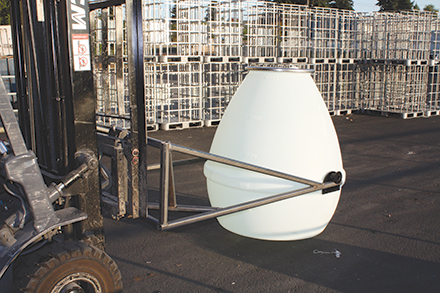 The permeable plastic that Flextanks are made of allows oxygen to enter at predictable rates.READ MORE »SEE EARLIER EDITIONS OF THIS COLUMN »
Grounded Grapegrowing
by Glenn McGourty
Vineyard Irrigation With a Limited Supply of Water
California and the other Pacific Coast states are facing an unprecedented drought. In California, calendar year 2013 was the driest year on record. Many large reservoirs and ponds are very low, and numerous water providers are curtailing water deliveries to their customers. The period from Nov. 13, 2013, to Jan. 31, 2014, were the driest winter months on record since weather records have been kept in California. Even though some storms have occurred since then, continued dryness and limited frost protection and irrigation water are likely to be issues for the 2014 growing season.
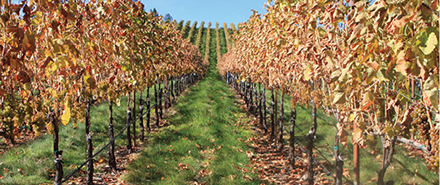 Although rain has brought the cover crop back to life, these vines are defoliating and fruit will only ripen by dehydration. Irrigating later into the growing season would have ripened the fruit sooner.READ MORE »SEE EARLIER EDITIONS OF THIS COLUMN »
Editor's Letter
by Jim Gordon
What the Farm Bill Means for Wine
Two events showered long-delayed and much-needed benefits on the wine industry as our staff prepared this issue of Wines & Vines. First, a drenching five-day rainstorm seemed to answer the prayers of thousands of California grapegrowers facing a critical shortage of water for the 2014 growing season.
READ MORE »SEE EARLIER EDITIONS OF THIS COLUMN »Inquiring Winemaker
by Tim Patterson
Do You Know What's Inside Your Barrel?
Split up the harvest of a small vineyard among five boutique wineries, do the winemaking in all cases along similar lines, and no one will be surprised when the results in the bottle all taste and smell noticeably different. But open up five barrels from the same cooperage, with the same toast level, and your jaw may drop at the variation on display.
READ MORE »SEE EARLIER EDITIONS OF THIS COLUMN »Vineyard View
by Cliff Ohmart
Evaluating Sustainable Certification Programs
More regional sustainable farming certification programs exist for winegrapes than for any other crop in the United States. By my count, there are six (see table at right). With so many options, it is worth discussing why there are so many programs and how to evaluate them.
After six years of hype, the Leonardo Academy (a nonprofit group dedicated to advancing sustainable agriculture, LEED building and fire suppression) has finally made available for public comment what they are calling the National Sustainable Ag Standards. This is their attempt to establish a single set of sustainable farming practice standards for all crops throughout the United States.
.jpg)
There are several reasons why the U.S. wine industry has been an incubator for so many sustainable wine-growing certification programs. First, wine grape growers are progressive and proactive, and they have formed trade associations in many regions to meet local wine grape-growing challenges, with several focusing on the sustainable growing of wine grapes.
READ MORE »SEE EARLIER EDITIONS OF THIS COLUMN »Editor's Letter
by Jim Gordon
Where Has All the Mustard Gone?
This is the 10th annual Barrel Issue of Wines & Vines, but the first thing on my mind as I write this column Jan. 20 is California’s drought. Officials declared the past year the driest in the state’s recorded history, and here we sit with virtually no rain in months, during the winter season when we normally see about two-thirds of our annual rainfall.READ MORE »SEE EARLIER EDITIONS OF THIS COLUMN »Inquiring Winemaker
by Tim Patterson
The Downside of a Cleaner, Gentler Crush Pad
In winemaking, as in so much of life, it’s possible to have too much of a good thing. A bumper crop in the vineyard is great, but over-cropped vines make lousy wine. Warmth is a fine thing for fermenting and extracting red grapes, but crank that must up to 110º F and your Petit Verdot will get deep-fried. Integrated oak is a good thing; egregious oak is a bad thing.In that spirit, it’s time to ask whether fruit can be too clean and crushing too gentle. Crush pads across the land are sporting more and more sophisticated equipment designed to deliver perfect berries to the ferment: shaking sorting tables that eliminate every leaf, fruit fly and stray jack, optical scanner-sorters that expel any berry deemed unfit, destemmers that don’t actually knock berries loose with paddles but rather calmly persuade them to self-deport from their pedicles. The War Against MOG has gone high-tech: Robots and drones may be on the way.
The aim of all this kinder, gentler, cleaner processing is maximizing the fruit character of the eventual wine and minimizing what seem like extraneous influences, and it’s hard to argue against that. Make wine from the fruits of the vineyard, not the detritus. It’s a perfectly plausible goal; nobody wants to make wine from grape leaves and gum wrappers and earwigs, and many winemakers are further determined to banish anything that might smack of those dreaded “green” flavors and to quarantine the allegedly nasty influences of grape seeds. Sure enough, squeaky-clean fruit makes super-fruity wine.
READ MORE »SEE EARLIER EDITIONS OF THIS COLUMN »Editor's Letter
by Jim Gordon
Economic Picture Bright for Wineries
This issue begins Wines & Vines’ 95th year of publishing. It also marks the 15th year that we’ve produced a special edition for the Unified Wine & Grape Symposium, which takes place Jan. 28-30 in Sacramento, Calif.
READ MORE »SEE EARLIER EDITIONS OF THIS COLUMN »Inquiring Winemaker
by Tim Patterson
Winemakers Rely on Living Equipment
What’s the most important piece of equipment in any winery?
Most of the gear buzz in the past few years has been about the nexus of sorting, destemming and (barely if at all) crushing: The quest for perfect, squeaky clean, absolutely intact berries at the start of fermentation. The choice of cooperages and toast levels in a barrel program can make or break a wine. Membranes do magical things. Flash Détente may save the world.
Of course, none of these gizmos come close to the most critical machinery in the cellar: the winemaker’s taste buds and his or her olfactory bulb. The reason wine is made by people and not computers or 3D printers is that some human has to taste and sniff the stuff all the way along the line and make dozens of decisions based on the mental readouts from these tiny little organs. It’s the place where art meets science in winemaking.
READ MORE »SEE EARLIER EDITIONS OF THIS COLUMN »Grounded Grapegrowing
by Glenn McGourty
A Tale of Two Watersheds
Farming in California is becoming increasingly complicated as growers in our populous state are held responsible for the wellbeing of public trust resources that are on their property: air, water, fish and wildlife. Agriculture is estimated to use 80%-85% of the available water in our state to irrigate about 10 million acres of farmland.
The most common conveyances of water in our state are naturally flowing rivers. Rivers serve many purposes including water for towns and cities, farms and wildlife. Managing to satisfy all of these needs is a challenge. There are few rivers left that flow naturally unimpeded, the result of many dams that have been constructed during the past 100-plus years. Since much of California exists under drought conditions for many months of the year, storing water when it rains makes great sense. Problems arise when these impoundments impact the natural hydrology of a region (movement of water and sediment through the rivers) and prevent fish or other wildlife from their former habitat. How water is apportioned for different uses creates much controversy, and balancing the needs of natural systems, agriculture and urban use is a never-ending task.
What is a watershed?
READ MORE »SEE EARLIER EDITIONS OF THIS COLUMN »
Inquiring Winemaker
by Charles G. Edwards
Can Brettanomyces Be Managed?
Editor’s note: Tim Patterson is on temporary leave from writing the Inquiring Winemaker column while he works on his next book. Winemaking researchers, teachers and professional winemakers will be contributing to this page during his absence.
Many people in the wine industry consider Brettanomyces to be a significant threat to red wine quality. During red wine aging (maturation), infected wines develop a number of off-odors and flavors, which range from clove, spicy, smoky, leather and cedar to more intense (and negative) descriptors as medicinal, Band–Aid, mousy, wet wool, barnyard or—in extreme situations—sewage. Although actual economic losses are not known, it is clear that the yeast remains a major headache for winemakers.
READ MORE »SEE EARLIER EDITIONS OF THIS COLUMN »Vineyard View
by Cliff Ohmart
How is Biodiversity Measured?
Increasing biodiversity in and around vineyards is often touted as one of the goals of sustainable winegrowing, and it is frequently mentioned as an important component of other sustainable cropping systems.
The term biodiversity is simple, but it describes an extremely important and complex property of a biological community.READ MORE »SEE EARLIER EDITIONS OF THIS COLUMN »
Viewpoint
by Chris Appleby
Is There a Market for Sulfite-Free Wine?
Consumers are increasingly seeking out natural food products, a trend that stems from a growing suspicion of additives and chemical preservatives. Because natural foods are commonly linked to good health and being better for the environment, products marketed in this way are often priced at a premium.READ MORE »SEE EARLIER EDITIONS OF THIS COLUMN »Editor's Letter
by Jim Gordon
Bigger, Better and More Practical
The merger of Practical Winery & Vineyard into the organization and pages of Wines & Vines, announced in January, is big news for our company and big news for you as a reader. Here is the story behind the announcement.
This merger has been in the works for some time.READ MORE »SEE EARLIER EDITIONS OF THIS COLUMN »
Inquiring Winemaker
by Bruce Zoecklein
Finding Balance in Viognier
Today’s consumers expect Viognier to be well balanced with a symphony of integrated aromas and flavors. Balance and harmony are two descriptors often used to denote quality, while unpleasant coarseness, aftertaste involving bitterness and/or excessive astringency or hotness can negatively impact this important varietal wine.READ MORE »SEE EARLIER EDITIONS OF THIS COLUMN »
Viewpoint
by Jeremy Benson
Massachusetts Laws Not Improving With Age
Today, 39 states representing 89.5% of the wine market allow for legal, regulated direct shipping of wine from wineries to consumers—but not Massachusetts. In fact, the Bay State holds a special place in our rankings of states on this issue.
By the numbers, Massachusetts is the seventh largest state for wine consumption and the largest without provisions allowing winery shipment.READ MORE »SEE EARLIER EDITIONS OF THIS COLUMN »Inquiring Winemaker
by Tim Patterson
Winemaking Comes In From the Cold
Oh, those irritating, crunchy little crystals. They’re called “wine diamonds,” but they’re about as welcome as bird droppings. They’re the potassium bitartrates that fall out of solution in wine at the least opportune moments—in the consumer’s refrigerator, just before the gala dinner party.READ MORE »SEE EARLIER EDITIONS OF THIS COLUMN »Grounded Grapegrowing
by Glenn McGourty
The Top Five Threats to Vineyard Health
READ MORE »SEE EARLIER EDITIONS OF THIS COLUMN »
Viewpoint
by Roger C. Bohmrich
Deconstructing Wine Myths
Wine is a subject obscured by myths, and in “Myths Challenge Industry Growth” (Wines & Vines February 2012 issue), Paul Franson provides a very useful service by highlighting several egregious examples.READ MORE »SEE EARLIER EDITIONS OF THIS COLUMN »
Technology
by Andrew Adams
Product News
Thermometer uses infrared technology
The DeltaTrak TCT thermometer is a dual-function thermometer that combines safe, non-contact surface temperature readings using infrared technology. Details: deltatrak.com.READ MORE »SEE EARLIER EDITIONS OF THIS COLUMN »Editor's Letter
by Jim Gordon
Who Gets Credit for Riper Wines?
Something is missing from the still-simmering debate about how high-alcohol table wines came to be today’s standard bearers.READ MORE »SEE EARLIER EDITIONS OF THIS COLUMN »Inquiring Winemaker
by Tim Patterson
Quality Measures Inch Forward
I’ve written a couple columns recently about winemaking additives, boosters and enhancements of various sorts—one about how winemakers pick and choose among the bewildering range of products out there, one about “natural” winemakers who do their best to use none of them and still make great wine.READ MORE »SEE EARLIER EDITIONS OF THIS COLUMN »Vineyard View
by Cliff Ohmart
PD Cure Not Near; Prevention Effective
It has been 12 years since glassy-winged sharpshooter (GWSS) infected 300 acres of grapevines in Temecula with Pierce’s disease, killing the vines and inciting panic in the California wine industry. That mini-disaster set in motion actions that led to the formation of the Pierce’s Disease Control Program (PDCP), which continues its work today. CLICK PHOTO TO PLAY VIDEO: Dr. Andy Walker, at UC Davis, talks about traditional plant breeding of Pierce’s disease resistant winegrape vines. Click here to see several researchers discuss their work to combat Pierce's Disease and the glassy-winged sharpshooter.READ MORE »SEE EARLIER EDITIONS OF THIS COLUMN »
Viewpoint
by W. Blake Gray
Imagining No TTB
In many industries, the term “government regulation” is almost a swear word. But the wine industry got a chance recently to imagine life without the TTB, and many found it dark and uncomfortable.
Last year, the White House Office of Management and Budget proposed eliminating the TTB in a memo to the Treasury Department.READ MORE »SEE EARLIER EDITIONS OF THIS COLUMN »Editor's Letter
by Jim Gordon
DtC Shipments Grow 13% in 2011
Now that the data are in for direct-to-consumer sales in 2011, and we can compare them to 2010, it’s time to share the good news coming from Wines & Vines' partnership with ShipCompliant, which makes valuable market research available to our readers.
The year that ended Dec. 31, 2011, was a very good one for wine clubs and other direct-shipping efforts.READ MORE »SEE EARLIER EDITIONS OF THIS COLUMN »Inquiring Winemaker
by Tim Patterson
European Oak Aims For Recognition
More often than not, options that look like either/or choices turn out to be not so binary after all. Paper or plastic? No thanks, I’ll just carry my reusable organically grown cotton tote bag. Coke or Pepsi? No way, Bubba, gimme an RC and a Moon Pie.READ MORE »SEE EARLIER EDITIONS OF THIS COLUMN »Grounded Grapegrowing
by Glenn McGourty
How Organic Growers Changed Viticulture
The recent publication of the “Organic Winegrowing Manual” (see story here) reminds me how the path unfolded to develop this different farming system used by growers who have now certified more than 11,000 organic acres under the USDA’s National Organic Program.READ MORE »SEE EARLIER EDITIONS OF THIS COLUMN »
Viewpoint
by Paul Franson
Myths Challenge Industry Growth
Many years ago, California winemakers convinced wine lovers that fine wines come in bottles and use corks. That campaign has come to hamper efforts to reduce costs, widen the market and even arguably improve some wines as increasing evidence demonstrates that inexpensive screwcaps are at least the equal of expensive corks for sealing wines.READ MORE »SEE EARLIER EDITIONS OF THIS COLUMN »Editor's Letter
by Jim Gordon
The To-Do List for 2012
With the new year comes a chance to improve yourself, your winery and your vineyard. Let’s leave the “yourself” part to other magazines like Oprah and Men’s Health, and focus on the other two. I think the wine industry now lives in a world quite different from that of 2007, when the wine business was firing on all eight cylinders.READ MORE »SEE EARLIER EDITIONS OF THIS COLUMN »Inquiring Winemaker
by Tim Patterson
Costs and Benefits of Additives
READ MORE »SEE EARLIER EDITIONS OF THIS COLUMN »Vineyard View
by Cliff Ohmart
Does Big Mean Unsustainable?
READ MORE »SEE EARLIER EDITIONS OF THIS COLUMN »Editor's Letter
by Jim Gordon
What Do Wine Writers Want?
When I returned to my routine in late February after the Symposium for Professional Wine Writers at Meadowood Napa Valley, I found myself thinking about what wine writers want. As a former full-time consumer wine writer and editor, I have a certain understanding of the craft that may help Wines & Vines readers see wine writers in a more accurate light.READ MORE »SEE EARLIER EDITIONS OF THIS COLUMN »Inquiring Winemaker
by Tim Patterson
Rethinking Barrel Materials
Elsewhere in this issue, Kerry Kirkham surveys the ins and outs of using the growing array of oak powders, chips, cubes and staves that can provide some of the flavors and tannins of oak barrels to tank-based wines. But there’s another, more radical alternative: Make the barrels themselves not from oak, but from stainless steel or plastic.READ MORE »SEE EARLIER EDITIONS OF THIS COLUMN »Grounded Grapegrowing
by Glenn McGourty
Tuning Your Vineyard For the Next Vintage
I am constantly amazed by the wonderful transition winegrowers experience between November and April. This rings especially true in the months since November 2010, when the harvest dragged on and on. Rain, late picking and numerous minor disasters ranging from mold to stuck tractors resulted in frayed nerves and tempers. As the cold, wet weather of late 2010 gave way to some lovely sunshine during January and February, everyone seemed to regain energy and optimism. Now they’re ready to take on a new grapegrowing year.
My friend Dave Koball, the chief viticulturist at Fetzer Vineyards, has a saying that I like: “My vineyards are like an orchestra, and my job is being the conductor. I need to get everything in tune and following the same beat.”
Good winegrowing is as much about timing as knowing precisely what to do. Most years the vines go from dormancy to bloom and full canopy expansion in a relatively short period of time—usually about 80 to 90 days. Weather can get in the way of many critical operations including spraying if it is windy or raining, waiting for shoots to grow if it is cool and then feeling hopelessly behind when winter suddenly disappears and summer seems to arrive overnight. Cool followed by hot makes shoots expand extra rapidly, and staying ahead of canopy management operations turns into a real challenge.
READ MORE »SEE EARLIER EDITIONS OF THIS COLUMN »
Viewpoint
by Patricia Howe
Why Reporting Units Should Be Standardized
The subject of standardized units must be one of the driest and most tiresome topics in the wine industry. Or so it would seem, until a winery experiences a dramatic and expensive unit-related misunderstanding such as a massive over addition of SO2, refermentation in bottles of “dry” wine or unanticipated spoilage in the barrel room.READ MORE »SEE EARLIER EDITIONS OF THIS COLUMN »Editor's Letter
by Jim Gordon
It's All About the Vines
Wine is made in the vineyard, right? Rarely do the fermentation tanks sit between the rows, but the essence of this overused aphorism is true. Even with all their skills and technology, winemakers can’t make great wine from average grapes.
Most winegrape growers have taken this concept to heart.READ MORE »SEE EARLIER EDITIONS OF THIS COLUMN »Inquiring Winemaker
by Tim Patterson
Big, Dry Reds: Just a Fad?
The big, extracted, tannic, alcoholic, dry reds that rule the wine world have been called many things by their detractors: awkward, clumsy, overblown, freakish, flammable, undrinkable. But the cruelest cut of all may be simply to note that in the grand historical sweep of things, they’re just a passing fancy.
That’s only one of the implications of the latest salvo from Tim Hanni, a master of wine and longtime nemesis of conventional wine wisdom. Hanni has been known to get up before an audience of wine educators and open with, “The biggest threat to the wine industry today is—wine education!” This time he’s brandishing a fistful of consumer research studies that suggest there’s a huge potential market of folks out there who would love to drink sweet wines—if only the industry had enough sense to offer them.
While Hanni is perfectly happy to climb out on a limb by himself, this time he’s hardly alone, as a recent one-day symposium about sweet wines at the University of California, Davis, indicated. (See “The Case for More Sweet Wine” at winesandvines.com.) The tenor of the day was captured with the title of the opening talk by Darrell Corti, one of the country’s leading authorities on fine wine traditions, “Sweet Wines: The Finest Wines in the World?”
Consumer phenotypes and industry prejudices
For years, Hanni’s mantra has been that the wine industry should put consumers and their preferences at the center of their outlook, rather than adopting arbitrary definitions of good and bad wines and figuring out how to convince consumers to get with the program. For the past two years, Hanni has been working with Dr. Virginia Utermohlen, a researcher at the Cornell University Taste Science Laboratory, on a long-term study of wine consumer attitudes, behavior and physiology. Their preliminary findings were issued in a report in December, both a $500 version with lots of juicy details and a free summary available at timhanni.com.
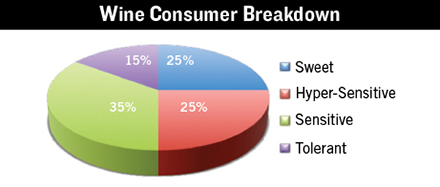
The study made use of online survey data from 1,200 wine drinkers responding not only to questions about wine preferences but about how people take their coffee, if they drink it at all, how much salt they like on their food, and so on. Previous work by numerous researchers has shown a strong correlation between these simple food and beverage preferences and human taste bud physiology: The black coffee crowd, for example, with its tolerance for bitterness, tends to have fewer, smaller and less sensitive taste buds than the cohort that dumps sugar and cream into its java. By combining the behavioral data from the survey—what kinds of wine people declared they did and didn’t like to drink—with the physiological profiles inferred from responses about coffee, salt and the like, they were able to construct four wine drinker “phenotypes.”
At opposite ends are Sweets—highly taste sensitive, preferring sweeter wines—and Tolerants—much less sensitive, able to tolerate harsh flavors and fond of big, red wines. In between are Hyper-Sensitives and Sensitives. How these categories are distributed in the real population—as opposed to the online survey population—is guesswork, but Hanni’s hunch is that Tolerants are a small minority, maybe 15%, almost all male, and that all the other phenotypes, including the Sweets, are larger.
Even though the Tolerants are often short on taste buds, their taste in wine dominates ratings, wine lists, wine education and wine pricing. For Hanni, this peculiar hierarchy not only flies in the face of physiological facts, it ignores a huge potential market for lighter, sweeter wines. And the reign of
the Tolerants is anything but tolerant: “Try going into an upscale, white tablecloth restaurant,” Hanni challenged the symposium attendees, “ask for a White Zinfandel, and see how you’re treated.”
Source: Tim HanniSugar and history
So if any of this is remotely true, how the heck did the Tolerants—the fans of killer Cabernet—become the masters of the wine universe?
Big, powerful, dry reds—from Bordeaux, Burgundy, Tuscany, Piedmont and Napa—have been the benchmark wines for “serious” wine drinkers for so long that it seems to be forever.READ MORE »SEE EARLIER EDITIONS OF THIS COLUMN »Vineyard View
by Cliff Ohmart
The 'Three Es' of Successful Spraying
Almost every grapegrower will spray his vineyard multiple times during the year, no matter whether he farms organically, Biodynamically or “conventionally.” That is due in large part to most grape varieties being very susceptible to one or more diseases. Most regions also have their share of insect, mite and weed pests that must be managed, often involving pesticide sprays.READ MORE »SEE EARLIER EDITIONS OF THIS COLUMN »
Viewpoint
by Jeff Carroll
Last Straw for Direct Shipping Holdouts?
Direct shipping will almost certainly come to Maryland consumers in 2011. However, the bigger story out of the Old Line State is the Direct Wine Shipment Report released by the comptroller Dec. 31, 2010.READ MORE »SEE EARLIER EDITIONS OF THIS COLUMN »Inquiring Winemaker
by Tim Patterson
Do We Still Need Winemakers?
For a glimpse of the future of wine, look no further than YouTube, where a short video reveals the automated operation of Siam Winery. You know it's the future because it's on YouTube, not in some wine magazine, and because it's from Thailand, yet another country getting into the wine business. We don't meet "the winemaker" in the video, but the clip does feature the Thai production engineer who speaks fluent German (a useful skill since the winery was designed by Siemens, not exactly a household name in German winemaking).
If you're not sold, think about this: They knock out 20 million bottles per month.
Closer to home, winemaker Sam Kaplan uses a considerable degree of high-tech automation at Arkenstone Vineyards in the Napa Valley. "I can do pump overs from my couch at home, watching TV with a nice cold beer in my hand," Kaplan says. "Wait," he added, "don't print that."
And here's the scoop on the ultra-modern Yalumba winery, courtesy of the Australian division of another venerable non-winemaking titan, Rockwell International:
"The primary user interface for the system is a fully redundant supervisory control and data acquisition (SCADA) server supported by five on-site clients, each running RSView Supervisory Edition from Rockwell Software. Winemakers and operators use the SCADA to specify process streams, crushing speeds and fermentation schedules--plus monitor the operational status of the entire plant. RSView Supervisory Edition provides unified site-wide monitoring and control via the RSView SCADA terminals and numerous plant-floor PanelView Plus human-machine interfaces (HMIs)."
Is a "human-machine interface" anything like a "great wine made in the vineyard?" Is this what all of us in the wine industry signed up for?
READ MORE »SEE EARLIER EDITIONS OF THIS COLUMN »Grounded Grapegrowing
by Glenn McGourty
Modern Wines From Ancient Greek Grapes
Greece inspires me on many levels. For my first visit there I arrived by boat, departing from Bari in Italy at night. We drifted in and out of the mist of an awesome dawn, as large puffy clouds reflected pink and golden light from the rising sun over the deep blue Adriatic Sea. I expected Triton to rise at any moment out of the water—or at least to hear some beautiful sirens singing from the rocky coast.
Once on land, I quickly realized that Greece is a bit of a fixer-upper. In its defense, the nation has been called the “crossroads of civilization,” and many of its visitors decided to stomp their feet as they passed through. Regardless, there is considerable charm in the overall landscape as well as the small towns and cities. You see rolling hills planted to olive trees and vines, and numerous antiquities from past civilizations dot the landscape. White plastered houses with bright blue trim and tiled roofs fill the villages. Tavernas with outdoor seating offer local delicacies and fun dining experiences.
The Greek people are courteous, warm and innately streetwise. If you have a differing opinion they smile politely, but you know that they really don’t give a darn what you think—they know what is right! Finally, there is a deep individualistic streak that makes it difficult for many Greek people to work together. Their two relatively successful wine promotional organizations, All About Greek Wine and Wine Roads of Northern Greece, continue to surprise and inspire good collaboration between their members.READ MORE »SEE EARLIER EDITIONS OF THIS COLUMN »
Viewpoint
by Cary M. Greene
Decision Threatens Winery Privileges
The Third Circuit Court of Appeals in Philadelphia recently issued a decision, Freeman v. Corzine, which represents a substantial threat to the status quo for state winery tasting room, self-distribution, event, festival, restaurant, farmers market and other local winery privileges.READ MORE »SEE EARLIER EDITIONS OF THIS COLUMN »Editor's Letter
by Jim Gordon
DtC Sales Up, Teen Drinking Down
The news in December leading up to press time for this issue carried very positive stories for wineries: An important segment of wine sales is up while teen drinking is down. Is there a connection?
Direct-to-consumer (DtC) shipments from U.S.READ MORE »SEE EARLIER EDITIONS OF THIS COLUMN »Inquiring Winemaker
by Tim Patterson
Is Barrel TCA the New Cork Taint?
Is contamination of French oak barrels by TCA the new cork taint? Or is this just old news wrapped in fresh press releases? That question may be the biggest 2010 year-end controversy in the wine trade, overshadowing old reliables like whether screwcaps make for clean wines or reduced wines, or whether genetically modified yeast is a swell idea or a non-starter.READ MORE »SEE EARLIER EDITIONS OF THIS COLUMN »Vineyard View
by Cliff Ohmart
Is IPM Dead?
The inspiration for this column came from a discussion that played out on the Association of Applied IPM Ecologists listserv (AAIE). AAIE’s mission is to provide “quality information about ecology-based pest management (IPM is short for integrated pest management), while encouraging environmentally compatible approaches and an awareness of IPM.READ MORE »SEE EARLIER EDITIONS OF THIS COLUMN »
Viewpoint
by Thomas Pellechia
Labels That Exploit Grandpa's Traditions
Osgood is my alter ego. He comes with me wherever I go just in case one of us has a bright idea that needs debating.READ MORE »SEE EARLIER EDITIONS OF THIS COLUMN »Editor's Letter
by Jim Gordon
Time to Renew PD Funding
It is time for California grapegrowers to renew their self-assessment to fund the ongoing fight against Pierce’s disease. At the current assessment rate of $1 per $1,000 of crop value, it has to be the world’s best bargain in disease prevention.READ MORE »SEE EARLIER EDITIONS OF THIS COLUMN »Inquiring Winemaker
by Tim Patterson
Yeast Terminology, Science and Marketing
Yeast is the undeniable heart of winemaking, the true winemaker that works the magic of fermentation while the rest of us watch and tinker around the edges. So it’s not surprising that a huge descriptive vocabulary has grown up around yeast, much like the proliferation of descriptors for wine itself. And like winespeak, some yeast talk is quite precise, and some fairly fuzzy.READ MORE »SEE EARLIER EDITIONS OF THIS COLUMN »Grounded Grapegrowing
by Glenn McGourty
Getting Sangiovese Right in California
The Sangiovese winegrape is a variety much admired and revered in Italy, where today it covers more than 11% of all vineyard area. Sangiovese represents 12% of Italian DOC and DOCG wines (the two highest categories of the Italian appellation system) and is included in the blend of 388 appellation-based wines. Although it’s planted in many parts of Italy, Tuscany remains the epicenter for high-quality Sangiovese, which is the main ingredient of all Chianti wines.READ MORE »SEE EARLIER EDITIONS OF THIS COLUMN »
Viewpoint
by Steve Dryden
Making Premium Wine In Baja California
In the northwest corner of Mexico, Baja California is home to nearly 40 wineries, but even international enophiles seem largely unaware of the region’s rapidly emerging wine industry. In 1521, Mexico became the first country in the New World to be planted to grapes.READ MORE »SEE EARLIER EDITIONS OF THIS COLUMN »
Wine Review Weekly
by Wine Opinions
March 22, 2010
Wine blogger Fredric Koeppel reports from Italy on a vertical tasting of Quorum Barbera d'Asti wines. In the San Jose Mercury News, columnist Laurie Daniel offers tasting notes on many Pinot Noir wines.
READ MORE »SEE EARLIER EDITIONS OF THIS COLUMN »Wine Review Weekly
by Wine Opinions
March 8, 2010
Eric Asimov, writing in the New York Times, offers an excellent profile of winemaker Paul Draper of Ridge Vineyards, whose 'minimalist' style has long set a standard of excellence for California wines.
READ MORE »SEE EARLIER EDITIONS OF THIS COLUMN »Editor's Letter
by Jim Gordon
Benefits of Science and Technology
Everybody loves the image of the little old vigneron trudging through his vineyard in the spring, beret on his head and hoe in his hand, sniffing the air for rain, making mental notes on the health of his vines, one by one, as he envisions the rich harvest to come in September.
As you know, however, there is a lot more to it than that.READ MORE »SEE EARLIER EDITIONS OF THIS COLUMN »
Wine East Opinion
by Hudson Cattell
Eastern Fruit Wines are 'Stealth' Wines
I’ve seen the term “stealth” applied to wines that get little notice; that is, they “fly under the radar.” Fruit wines could be called stealth wines simply because in comparison with grape wines they get little attention in the wine world, even though increasingly more wineries are making them and many consumers like them.READ MORE »SEE EARLIER EDITIONS OF THIS COLUMN »Inquiring Winemaker
by Tim Patterson
Wine From Sludge: Lees Filtration
Recovering good wine from gooey lees seems like such a good idea.READ MORE »SEE EARLIER EDITIONS OF THIS COLUMN »Vineyard View
by Cliff Ohmart
How Can a Vineyard Be Carbon Neutral?
Unless he’s been in a cave for the past five years without access to any kind of media, it is impossible for a winegrape grower not to have been confronted with the concept of a vineyard’s carbon footprint, or to have come across someone claiming to have a carbon-neutral vineyard.READ MORE »SEE EARLIER EDITIONS OF THIS COLUMN »Viewpoint
by Cary M. Greene
Allow Vintage Dating
A winery might have plenty of reasons to use a vintage date on an “American” or other country appellation wine. But under longstanding federal regulations, wineries don’t have the option, since country appellation wines are prohibited from bearing a vintage date.READ MORE »SEE EARLIER EDITIONS OF THIS COLUMN »Faces & Forums
by Jim Gordon
You've Gotta Know When to Hold 'Em
Sacramento, Calif. -- Nat DiBuduo of the Allied Grape Growers spoke at the State of the Industry session at the Unified Wine & Grape Symposium in late January.
DiBuduo, a grapegrower himself, focused on the current supply of California grapes by variety and gave cautious advice about what varieties might be worth planting more of.
He said Chardonnay was in a mostly balanced situation of supply and demand. Sauvignon Blanc looks weak to stable, and he advised growers not to plant more.
Cabernet Sauvignon did not increase in supply, and demand for the variety is still good, but DiBuduo cautioned not to plant more without a contract.
Grafting-over and pullouts of Merlot vines have been common recently, to match the weaker demand. Now the outlook is stable. Pinot Noir demand is strong, but DiBuduo expects the supply will continue to grow through 2012 based on recent plantings, and he didn’t advise planting even more.
Syrah demand remains weak. Zinfandel acreage is decreasing due to lower demand for white Zinfandel. Don’t plant Zinfandel, he advised, but don’t pull out any old-vine Zinfandel, “because you just can’t plant new old vines.”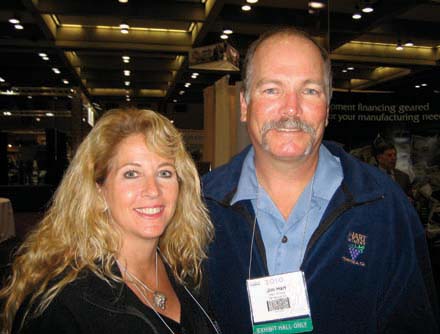 Christine and Jim Hart represent Hart Family Winery of California's Temecula Valley.
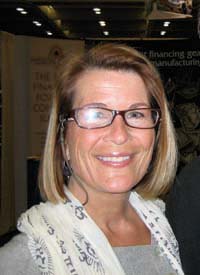 Cynthia Bennett seeks innovations she can put to use at Sogn Valley Vineyard in Kenyon, Minn.READ MORE »SEE EARLIER EDITIONS OF THIS COLUMN »
Wine Review Weekly
by Wine Opinions
February 22, 2010
Syrah wines from Sonoma County get the attention of the San Francisco Chronicle tasting panel this week.
READ MORE »SEE EARLIER EDITIONS OF THIS COLUMN »Wine Review Weekly
by Wine Opinions
February 8, 2010
Wine columnist Eric Asimov, writing in the New York Times, has mostly faint priase for Pinot Gris wines from Oregon. In the San Jose Mercury News, columnist Laurie Daniel reports glowingly on many wines from the Ribera del Duero.
READ MORE »SEE EARLIER EDITIONS OF THIS COLUMN »Editor's Letter
by Jim Gordon
Tasting Blind Is Not Just for Critics
Do you as a winemaker hope that wine writers and trade buyers taste your wine blind? Do you want them to base their decisions on what’s in the tasting glass, or do you want them to carry along their prejudices against your AVA, your brand, your price-point or, God forbid, your personality?
I am guessing that most winemakers would say, “Yes: I want my wines to be judged blind.READ MORE »SEE EARLIER EDITIONS OF THIS COLUMN »Inquiring Winemaker
by Tim Patterson
With Fermenters, Does Size Matter?
When it comes to fermenter size, is smaller always more beautiful? Most of us are pretty well hard-wired to think that’s true.
Quick now, summon up an image of a small fermentation vessel; what probably comes to mind is a little old (or earnest young) winemaker, doing a hand punch-down, eagerly trying to tease some terroir out of the fruit.READ MORE »SEE EARLIER EDITIONS OF THIS COLUMN »Grounded Grapegrowing
by Glenn McGourty
Back to the Future: Dry Farming
California is in some respects reaching the limits of its water resources. The various stakeholders that need water are now starting to actively compete for this important “public trust resource.” Essentially, the state of California owns and controls the use of all surface water -- and, in some instances, groundwater as well.READ MORE »SEE EARLIER EDITIONS OF THIS COLUMN »
Viewpoint
by Pietro Buttitta
Sans Soufre
Sans soufre. Without sulfur. Everything sounds more profound in French.READ MORE »SEE EARLIER EDITIONS OF THIS COLUMN »
Faces & Forums
by Kate Lavin
Rock Wall Shows Off New Space
Alameda, Calif. -- Artist Shauna Rosenblum grew up learning about winemaking from her father, Kent Rosenblum, whose home winemaking hobby eventually grew to include world-class Zinfandel created in a cellar on Alameda Island, between San Francisco and Oakland.
During the past year, the father-and-daughter team have grown another dream into reality: the Rock Wall Wine Co., where they can not only produce wine together -- the setup also allows seven other small wineries to produce their wares under one roof, Building 24, a former airplane hangar on a retired naval base.
In December, the Rosenblums showcased their own Rock Wall Wines along with the other wineries at Rock Wall: Blacksmith Cellars, Carica Wines, Ehrenberg Cellars, JRE Wines, R&B Cellars and Virgo Cellars. The event, labeled a holiday bazaar, included the opportunity to take photos with Santa, listen to live music, take winery tours and taste everything from unreleased sparkling Grenache to a Chenin Blanc varietal to late-harvest Zinfandel.
For more information about Rock Wall’s urban winery concept -- or to link to any of its member wineries -- visit rockwallwineco.com. John Choppy pours Rock Wall Wines 2007
Petite Sirah from Mendocino County. Guests Leanna Bradford and Marilyn Byus
don festive hats for the Holiday Bazaar
Open House.READ MORE »SEE EARLIER EDITIONS OF THIS COLUMN »Wine Review Weekly
by Wine Opinions
February 1, 2010
Wine columnist Dave McIntyre of the Washington Post has lots of nice things to say for Malbec wines from Argentina, while in the Nashville Tennesean wine writer Frank Sutherland offers praise for the Carmenere wines of Chile.
READ MORE »SEE EARLIER EDITIONS OF THIS COLUMN »Editor's Letter
by Jim Gordon
Keep the Green Message Simple
Could it be that the wine industry’s considerable effort to go green and then to communicate this movement to customers has failed? Even worse than that, could the whole thing be on the verge of backfiring and turning wine drinkers off the whole concept?
I took those questions home from last month’s Green Wine Summit in Santa Rosa, Calif.READ MORE »SEE EARLIER EDITIONS OF THIS COLUMN »Inquiring Winemaker
by Tim Patterson
Geo-Scientists Dig Into Terroir
READ MORE »SEE EARLIER EDITIONS OF THIS COLUMN »Vineyard View
by Cliff Ohmart
Certification 101: What Suits Your Vineyard?
READ MORE »SEE EARLIER EDITIONS OF THIS COLUMN »
Viewpoint
by Jason Haas
Does Social Media Sell? No, But Use It Anyway
In early November, I sat on an industry panel in Paso Robles, Calif., to share ideas about the possibilities of social networking. The three of us on the panel were chosen because we were early adopters of blogs, Facebook, and/or Twitter.
READ MORE »SEE EARLIER EDITIONS OF THIS COLUMN »Faces & Forums
by Kate Lavin
Going Green on Their Own Terms
San Luis Obispo, Calif. -- Does green farming net greenbacks for farmers? In preparing its annual Sustainable Ag Expo held Nov. 16-17, the Central Coast Vineyard Team saved that key question for the last session, Sustainability Initiatives in the Marketplace.
READ MORE »SEE EARLIER EDITIONS OF THIS COLUMN »Editor's Letter
by Jim Gordon
An All-American Appellation
This month's column revisits a topic I first addressed here in March 2007. Then just a discussion of truth in labeling, now it has evolved into a concrete proposal that would rectify a very poorly conceived section of the federal rules on wine labeling. An interstate coalition of winegrape grower groups has now petitioned the Alcohol and Tobacco Tax & Trade Bureau (TTB) to revise the rules.READ MORE »SEE EARLIER EDITIONS OF THIS COLUMN »Inquiring Winemaker
by Tim Patterson
Yeast Genetics Without GMOs
READ MORE »SEE EARLIER EDITIONS OF THIS COLUMN »
Viewpoint
by Rob Davis
What Chardonnay Taught Me About Site Selection
'Great wines are associated with particular vineyards,' Tom Jordan told me in 1976. I agree. When I was a student at the University of California, Davis, my enology professor, Dr.
READ MORE »SEE EARLIER EDITIONS OF THIS COLUMN »Faces & Forums
by Wines & Vines
WAWGG Hosts Bigger Crowd
 Walla Walla Community College students Quentin Mylet (left) and Michael Penn received scholarships. Philippe Michel (left) shares a laugh with Allen Shoup during the trade show reception.
PHOTO: Peter MithamMore than 1,300 growers and vintners set an attendance record at the annual meeting of the Washington Association of Wine Grape Growers during the first week of February in Kennewick, Wash.READ MORE »SEE EARLIER EDITIONS OF THIS COLUMN »Editor's Letter
by Jim Gordon
Huge Tax Increase Appears Dead
California grapegrowers and winemakers in the second week of February exhaled with relief upon hearing that no support materialized in the leadership of the state legislature for Gov. Arnold Schwarzenegger's misnamed "Nickel-a-Drink" tax proposal. The state's budget crisis continued, but it was clear that the proposed tax increase of 640% on wine had no legs to stand on--at least for now.READ MORE »SEE EARLIER EDITIONS OF THIS COLUMN »Inquiring Winemaker
by Tim Patterson
Weighing the Term 'Balance'
READ MORE »SEE EARLIER EDITIONS OF THIS COLUMN »Vineyard View
by Cliff Ohmart
Elicitors Put Vines in Charge
In keeping with this issue's theme of vineyard equipment and technology, I will discuss a topic that readers might not think of right away when contemplating technological advances in viticulture. Not only have there been advances in things like vineyard equipment, computer software and new approaches to canopy management, there also have been advances in pesticide chemistry. Much of the change has been driven by the need for pesticides that are effective but have less negative environmental impact than the old pesticide chemistries.
Plant host inducers, or "elicitors," belong to one of the most intriguing classes of the new generation of pesticides. These chemicals do just what their name implies: When sprayed on a grapevine, they induce or elicit a chemical response that is intended to control or prevent pest problems--or, in relation to pathogens, prevent them from causing disease.
READ MORE »SEE EARLIER EDITIONS OF THIS COLUMN »
Viewpoint
by Hank Salvo
Seven Key Actions to Ride Out the Economy
All the economic forecasts I read for a global turnaround vary from eight months to 18 months or more. The wine industry is showing that it is not immune to the impacts of this recession. While we all tend to get wrapped up in the operations of our businesses, now more than ever it is important to step back and take key actions to grow cash.READ MORE »SEE EARLIER EDITIONS OF THIS COLUMN »Faces & Forums
by Kate Lavin
Unified Boosts Attendance
 Jon Fredrikson (left) discusses California's proposed 'nickel-a-drink' tax. (right) Greg Gessner (left) and Chris Phelps chat outside a session at Unified.
LEFT PHOTO: Ken FreezeSacramento, Calif. -- About 11,900 wine industry professionals attended the Unified Wine & Grape Symposium in late January, topping last year's attendance figure by 400.READ MORE »SEE EARLIER EDITIONS OF THIS COLUMN »
Viewpoint
by Jane Firstenfeld
Keep the Green Light On
What happens when you put five gods of green on one panel to talk about business? At the Green Wine Summit in December, you got a standing-room-only audience, unexpected humor and a reality check about the famous triple bottom line of sustainability. It was inspiring in unanticipated ways.READ MORE »SEE EARLIER EDITIONS OF THIS COLUMN »Inquiring Winemaker
by Tim Patterson
DAP: Easy Does It
READ MORE »SEE EARLIER EDITIONS OF THIS COLUMN »Editor's Letter
by Jim Gordon
The Challenge of Barrel Buying
I feel for the unlucky winemakers who have to make barrel-buying decisions now for their 2009 harvests--and that's most of you out there. It's too early in the year to estimate the size of your crop, yet if you wait until late spring or early summer, when the fruit has set and you can make a rough estimate of yields, you may miss getting the barrels you want at reasonable prices.READ MORE »SEE EARLIER EDITIONS OF THIS COLUMN »Faces & Forums
by Kate Lavin
Winemakers Unite in San Francisco
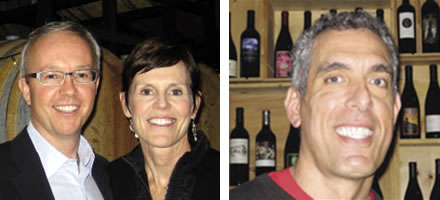 Joann and Matt Reidy's wine label (left), Connor Brennan Cellars, is named after their sons.John Tarabini (right) is president of the San Francisco Wine Association and Damian Rae Winery.
PHOTO: Bridget WilliamsSan Francisco, Calif. -- Making wine for their Damian Rae label at Crushpad the last four years, John and Sharol Tarabini befriended dozens of fellow boutique winery owners. The family-owned wineries there produced between 50 and 500 cases annually, and the principals possessed a love for sharing the wine they'd made.READ MORE »SEE EARLIER EDITIONS OF THIS COLUMN »Editor's Letter
by Jim Gordon
The Outlook for Wine Sales
How morbidly appropriate that the wine business was rocked by a sales slump of historic proportions just as our staff prepared this 90th anniversary edition of Wines & Vines. No one in the business that I've spoken to can remember a more depressing period for sales than what happened in the second half of 2008.READ MORE »SEE EARLIER EDITIONS OF THIS COLUMN »Vineyard View
by Cliff Ohmart
Why Does IPM Lag In Europe and the U.S.?
I recently returned from the ENDURE Conference in La Grande Motte, France. I was invited to give a plenary talk on the topic of impediments California growers face in adopting Integrated Pest Management (IPM), and how to get around them.READ MORE »SEE EARLIER EDITIONS OF THIS COLUMN »
Viewpoint
by Nat DiBuduo
Sustainable Growing Starts With Pricing
The surplus of winegrapes in California appears to be over. Due to drought, frost, spring winds and heat spells, the 2008 winegrape crop is estimated to be smaller than 2007's statewide. I expect the 2008 crop will come in below 3 million tons--significantly lower than the 3.4 million tons estimated by California Agricultural Statistic Service.READ MORE »SEE EARLIER EDITIONS OF THIS COLUMN »Faces & Forums
by Kate Lavin
Expo Promotes Green Growth
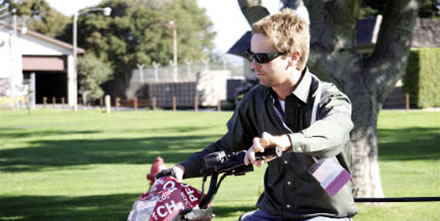 Julian Malone of Scheid Vineyards takes an electric ATV from Barefoot Motors, one of dozens of exhibitors, out for a spin around the lawn of the Monterey Fairgrounds.Monterey, Calif. -- About 350 viticulturists and other specialty farmers soaked up information on eco-friendly business practices during the Sustainable Ag Expo held at the Monterey Fairgrounds. The Central Coast Vineyard Team organized the Nov.READ MORE »SEE EARLIER EDITIONS OF THIS COLUMN »
Editor's Letter
by Jim Gordon
Making Money the Hard Way
The vitality of the Oregon wine industry struck me while spending a few days in Eugene recently. The No. 4 state in wine production has always hoed its own row, and now gets to enjoy the fruits of that hard labor.READ MORE »SEE EARLIER EDITIONS OF THIS COLUMN »Inquiring Winemaker
by Tim Patterson
Going Wild In the Cellar
What's in it? Where will it go? Fermenting with wild yeast can be risky business, but for many daring winemakers, it's a risk worth taking.READ MORE »SEE EARLIER EDITIONS OF THIS COLUMN »
Viewpoint
by Bill Nelson
'Serving Facts' Serve Whom?
The Tax and Trade Bureau of the Treasury Department (TTB) is currently reviewing comments on a rulemaking proposal to mandate a "serving facts" information panel on all alcohol beverage labels, in type larger than two millimeters, set off in a box, and specifying alcohol content by volume, calorie and nutrient information (carbohydrate, fat and protein).READ MORE »SEE EARLIER EDITIONS OF THIS COLUMN »
Faces & Forums
by Peter Mitham
Sustainability In Washington
Andrea Anderson, Washington Wine Grape Industry Foundation with WAWGG's Vicky Scharlau.
Gary Grove, WSU Prosser and Wayne Wilcox, of Cornell's Geneva, N.Y. research station.READ MORE »SEE EARLIER EDITIONS OF THIS COLUMN »Editor's Letter
by Jim Gordon
A Closer Look at the Elephant
California's Grape Crush Report reminds me of the fable about a village in India inhabited by blind men, that has its first visit from an elephant. They perceive the elephant quite differently. You know, one touches the elephant's leg and says an elephant is like a pillar.READ MORE »SEE EARLIER EDITIONS OF THIS COLUMN »Inquiring Winemaker
by Tim Patterson
Anyone Remember GWSS?
READ MORE »SEE EARLIER EDITIONS OF THIS COLUMN »Vineyard View
by Cliff Ohmart
Brainstorming on Pierce's Disease
Many attendees appreciated the introduction of roundtable sessions, where researchers discussed specific topics.READ MORE »SEE EARLIER EDITIONS OF THIS COLUMN »
Viewpoint
by Tyler Thomas
Our Skepticism of Science
People love the phrase "in vino veritas"--in wine there is truth. But I wonder sometimes whether "in vino scientia" holds as well.READ MORE »SEE EARLIER EDITIONS OF THIS COLUMN »Faces & Forums
by Jim Gordon
Unified Symposium Sets New Record
John Fredrickson of the Gomberg Fredrickson Report noted that California wine shipments were up by 2% last year, but grew more slowly than imports.
PHOTOS: Ken Freeze/Brown Miller CommunicationsSacramento, Calif. -- The turnout was so big for the Wednesday morning session of the Unified Wine & Grape Symposium that one speaker suggested that next year's event be moved to a stadium. He was exaggerating, but organizers of the expanded four-day event said this year's attendance was up by 1,100 over last year's, and set a new record of 11,500.READ MORE »SEE EARLIER EDITIONS OF THIS COLUMN »Editor's Letter
by Jim Gordon
A Close Look at Barrels
If you've been to Europe in the last couple of years you know how little respect the dollar gets there. The traveler's rough math is: one euro equals one and a half dollars. So the 50-euro per day rental car is about $75 to you.READ MORE »SEE EARLIER EDITIONS OF THIS COLUMN »Inquiring Winemaker
by Tim Patterson
'Food-Friendly' Winemaking
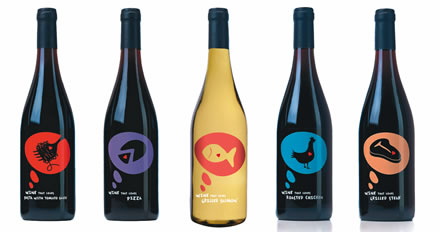
Wine That Loves names its wines for popular American foods to make pairing a no-brainer.READ MORE »SEE EARLIER EDITIONS OF THIS COLUMN »
Viewpoint
by Josh Hermsmeyer
Direct Packaging Is Lame
I'll get this out of the way right up front: Direct-to-consumer wine packaging is lame. Minimalist. Underwhelming.READ MORE »SEE EARLIER EDITIONS OF THIS COLUMN »Faces & Forums
by Wines & Vines staff
Pierce's Disease Symposium
Attendees sipped wine and mingled during poster sessions.San Diego, Calif. -- The California Department of Food and Agriculture brought together top researchers, concerned grapegrowers and other industry stakeholders to share insights and progress reports on the continuing battle against Pierce's disease (PD). Held in San Diego on Dec.READ MORE »SEE EARLIER EDITIONS OF THIS COLUMN »Inquiring Winemaker
by Tim Patterson
Residual Sugar-- 'How Sweet It Is'
Several decades back, before most of you could drink wine legally, before half of you were born, comedian Jackie Gleason built a career around the catchphrase, "How sweet it is," (revived for the title of his 1966 album, released by Columbia Records, at right) a pithy celebration of someone else's bad fortune.READ MORE »SEE EARLIER EDITIONS OF THIS COLUMN »Editor's Letter
by Jim Gordon
Do 'AVA Owners' Have Rights?
The TTB took a little pressure off its proposed AVA regulation overhaul in December when it extended the comment period on two controversial notices until March 20, 2008. This was a good move. But it also extends the period of limbo for proposed AVAs seeking approval, which is not good for the growers and wineries involved.READ MORE »SEE EARLIER EDITIONS OF THIS COLUMN »Inquiring Winemaker
by Tim Patterson
Power of Technology
READ MORE »SEE EARLIER EDITIONS OF THIS COLUMN »Vineyard View
by Cliff Ohmart
Rough Start for National Standards
READ MORE »SEE EARLIER EDITIONS OF THIS COLUMN »
Viewpoint
by By Fred Koeppel
Wine Label Marketing Babble: When will it end?
If I want to read a book, I don't pick up a bottle of wine, but so many labels nowadays carry elaborate narratives and back-stories that are supposed to make the wine more "interesting" or "enticing" or "hip" (especially hip) that buying wine is like reading the back of the cereal box at breakfast.READ MORE »SEE EARLIER EDITIONS OF THIS COLUMN »
Faces & Forums
by Laurie Daniel
Marketing Sustainability
Attendees, from left, Fritz Helzer, Mesa Vineyard Management (MVM); Jim Seay; Bryan Wallingford, MVM; Greg Hibbits, MVM; Stasi Seay, Diageo Chateau & Estates; Darryl Salm, Valley Farm Management.
PHOTOS: Dave CoronelPaso Robles, Calif. -- As more growers and wineries adopt sustainable practices, how can they get that message out to consumers? Do consumers even care if a wine is sustainably produced? Sustainability in the marketplace was a key topic at the Central Coast Vineyard Team's third annual Sustainable Ag Expo, held Nov. 1 and 2 at the Paso Robles Event Center.READ MORE »SEE EARLIER EDITIONS OF THIS COLUMN »Editor's Letter
by Jim Gordon
Letting Oak Chips Out of the Bag
It's time to bring oak alternatives further out in the open. Continuing to hide these very common winemaking tools invites the wine trade and the public to conclude that there is something wrong with barrel staves, oak chips, balls, spirals and sticks. But there is nothing inherently wrong.READ MORE »SEE EARLIER EDITIONS OF THIS COLUMN »Inquiring Winemaker
by Tim Patterson
More on Toothsome Tannin Terms
READ MORE »SEE EARLIER EDITIONS OF THIS COLUMN »
Viewpoint
by Mike Lynch
Slipping Into Darkness, or: The Gospel Truth of Pinot Noir
"Bless me, Father, for I have sinned. It has been 40 years since my last confession."
"You're telling me you haven't been to confession since the year 'Mr.READ MORE »SEE EARLIER EDITIONS OF THIS COLUMN »Faces & Forums
by Jim Gordon
Faces & Forums
A new attendance record of 1,056 was set at the Washington Association of Winegrape Growers (WAWGG) annual meeting, conference and trade show held in Kennewick, Wash. Growers, suppliers and winemakers gathered Feb.
Keith and Camille Klingele, left, of Snipes Canyon Ranch in the Yakima Valley, greet fellow Yakima grower Dick Boushey.
Photos: Joel Waite
Christina Messer, director of the Washington state field office of the USDA-NASS, toasts winemaker Gordon Hill of Milbrandt Vineyards.READ MORE »SEE EARLIER EDITIONS OF THIS COLUMN »Editor's Letter
by Jim Gordon
The Un-American Appellation
The issue of whether wines labeled as "American" should be allowed to contain 25% of wine from other countries has been simmering for two years, and now it's starting to boil. Currently, federal regulations include this loophole--which is big enough to sail a tanker full of Australian Shiraz through--and a number of American winegrape growers don't like it.READ MORE »SEE EARLIER EDITIONS OF THIS COLUMN »Vineyard View
by Cliff Ohmart
The Commodification Of the Winegrape
READ MORE »SEE EARLIER EDITIONS OF THIS COLUMN »
Viewpoint
by Dan Berger
A Warning Label About Nothing
If the U.S. government gets its way, wine bottles could well have four information labels imposed on them--and one of them would be a fraud.
One of the labels being sought is simply a statement of how many "standard drinks" are in a bottle of wine, based entirely on the wine's alcohol content.READ MORE »SEE EARLIER EDITIONS OF THIS COLUMN »Faces & Forums
by Jim Gordon
Faces & Forums
Karen Ross (at lectern) of CAWG welcomed the audience before a program on human resources with (from left) Yesenia Plascencia, Ron Barsamian, Donna Bowman, Fred Philpott, and Andrew Waterhouse.Indications of how positive an economic outlook the wine industry currently faces were not hard to find at the annual Unified Wine & Grape Symposium in Sacramento, Calif., Jan. 23-25.READ MORE »SEE EARLIER EDITIONS OF THIS COLUMN »Editor's Letter
by Jim Gordon
Winemaker, Know Thy Barrels
I bought my first wine barrel from Mike Grgich 16 years ago. I had interviewed him for a magazine cover story at about that time, and I was impressed with how neat and clean the Grgich Hills cellar looked, and how meticulous the winery's regimen of tasting, racking, topping and sanitation was.READ MORE »SEE EARLIER EDITIONS OF THIS COLUMN »Inquiring Winemaker
by Tim Patterson
Toothsome Tannin Terms--Part I
READ MORE »SEE EARLIER EDITIONS OF THIS COLUMN »Viewpoint
by Mike Lynch
The Press Release
A dialogue between PR pro and prospective client.
"Do you write press releases?"
"I do."
"Good, I need a press release.READ MORE »SEE EARLIER EDITIONS OF THIS COLUMN »Editor's Letter
by Jim Gordon
The AVF's Search for Answers
"It seems to work for us, but we don't really know why. There's not enough science to base it on."
I lost track of how many times I heard this quote from winemakers and vineyard managers last year.READ MORE »SEE EARLIER EDITIONS OF THIS COLUMN »Vineyard View
by Cliff Ohmart
Getting Ready for the GMO Debate
READ MORE »SEE EARLIER EDITIONS OF THIS COLUMN »
Viewpoint
by Christopher Sawyer
Defending the Sommeliers
In the September issue of W&V, I read a thought-provoking editorial by Bryan Garbutt, "Getting Past The Millennial Gatekeepers." In a nutshell, Garbutt argued that many of the young sommeliers and wine buyers, 21-29 years of age, are basically too adventurous in their selections of wines and out of the loop about the concept of brand loyalty.READ MORE »SEE EARLIER EDITIONS OF THIS COLUMN »Faces & Forums
by Jim Gordon
Faces & Forums
Three substantive seminars for grapegrowers and their crews highlighted the Napa Valley Viticultural Fair Nov. 14, providing education on leafroll virus, the cost to growers of extended hang time and, en Español, an overview of grapevine pests and diseases.
Pete Richmond, a director of the NVG, with Jennifer Kopp, the organization's executive director.
Photos: John Putnam & Jim Gordon
Vineyard manager and boutique winery owner Ron Wicker (left) gets a glassful from NVG director Dale Brown during the post-fair wine hour.READ MORE »SEE EARLIER EDITIONS OF THIS COLUMN »
Editor's Letter
by Larry Walker
The Impact Of Vineyard Technology
The use of new vineyard technology and related technical advances can make a huge difference to the wine in the bottle, that's common knowledge. But the impact may go beyond that. Some industry observers believe that the mind-boggling grape harvest of 2005 may be traced to technical advances in irrigation technology and trellis applications.READ MORE »SEE EARLIER EDITIONS OF THIS COLUMN »Inquiring Winemaker
by Tim Patterson
The Tannin Addition Bandwagon
Judging from the recent rise in popularity of tannin additions in California winemaking, you could be excused for thinking grapes from the Golden State must not contain any tannins of their own. And you might be tempted to feel sorry for the poor souls who made wine for nearly 7,000 years without benefit of these apparently indispensable aids.READ MORE »SEE EARLIER EDITIONS OF THIS COLUMN »
Viewpoint
by Lucian Dressel
Have Intrastate Wine Competitions Outlived Their Usefulness?
Many states, such as New York, Missouri and Illinois, still have "closed" yearly wine competitions that out-of-state wineries are barred from entering. This is in sharp contrast to states such as Indiana, where the competition is "open" and entries are encouraged from all 50 states and foreign countries.READ MORE »SEE EARLIER EDITIONS OF THIS COLUMN »Editor's Letter
by Larry Walker
Kicking The Dirt
It has become a wine public relations cliché that all great wine starts with the grower in the vineyard. But like many other clichés, it is based on solid reality.
This is our grower issue of Wines & Vines.READ MORE »SEE EARLIER EDITIONS OF THIS COLUMN »Vineyard View
by Cliff Ohmart
Environmental Management Systems
In my October 2004 column, I proposed three challenges to implementing sustainable viticulture: defining it, measuring it and implementing it. Since then I have become familiar with an approach to sustainable planning and implementation that appears to be a great way to meet these three challenges. It is known as Environmental Management Systems, or simply EMS.READ MORE »SEE EARLIER EDITIONS OF THIS COLUMN »Viewpoint
by Larry Walker
Look for the (Global) Black Cloud
The optimism was so thick in the aisles of the Unified Wine & Grape Symposium in Sacramento a few weeks ago that you could scoop it onto your apple pie and have Good News du Jour a la Mode.
Everyone I talked to was filled with good cheer. There was talk of the United States being the world's biggest wine market by the end of the decade.READ MORE »SEE EARLIER EDITIONS OF THIS COLUMN »Editor's Letter
by Larry Walker
Keep Those Barrels Rolling
The production of barrels has come a long way since wine was shipped in palmwood casks from Armenia to Babylon thousands of years ago, B.C. In the following centuries, wooden barrels were used to transport wines in most areas of the winemaking world.READ MORE »SEE EARLIER EDITIONS OF THIS COLUMN »Inquiring Winemaker
by Tim Patterson
Making Pinot Noir
Is Pinot Noir really all that hard a wine to make? Or is it just that Pinot producers whine more than other winemakers?
The possibility that Pinot Noir is really an easy wine has been haunting me ever since two commercial winemakers I consulted for another Pinot article--both from wineries featured in the film "Sideways"--volunteered that it is basically a piece of cake.READ MORE »SEE EARLIER EDITIONS OF THIS COLUMN »
Viewpoint
by Mat Garretson
Another Hot Topic
Be it fashion, cars or food, American consumers are seemingly obsessed with fads, and the wine trade is no exception. Each and every year sees the emergence of a darling new buzz word that's bandied about by our nation's retailers, restaurateurs, distributors and wine press. Canopy management, terroir, brettanomyces and TCA have all had their day in the sun.READ MORE »SEE EARLIER EDITIONS OF THIS COLUMN »Editor's Letter
by Larry Walker
Getting Started
Good grief!
It's another new year. And with that new year, new plans, new goals, new dreams.
For those of us in the wine industry, the Unified Wine & Grape Symposium, to be held Jan.READ MORE »SEE EARLIER EDITIONS OF THIS COLUMN »Vineyard View
by Cliff Ohmart
The Lodi Rules for Sustainable Winegrowing
The Lodi-Woodbridge Winegrape Commission (LWWC) recently launched a third-party certification program for the sustainable production of winegrapes, The Lodi Rules for Sustainable Winegrowing. It is California's first regional sustainable winegrowing certification program that has been peer reviewed by scientists, consultants and environmental organizations.READ MORE »SEE EARLIER EDITIONS OF THIS COLUMN »
Viewpoint
by Jamie Goode
GM Vines: Is The Price Worth Paying
The possible introduction of genetically modified (GM) grapevines into California vineyards is currently causing heated debate. At one extreme, scientists are so familiar with the use of genetic modification as a research technique, they can't see what all the fuss is about. At the other extreme, tree-hugging environmentalists see GM crops as a threat to be resisted at all costs.READ MORE »SEE EARLIER EDITIONS OF THIS COLUMN »